

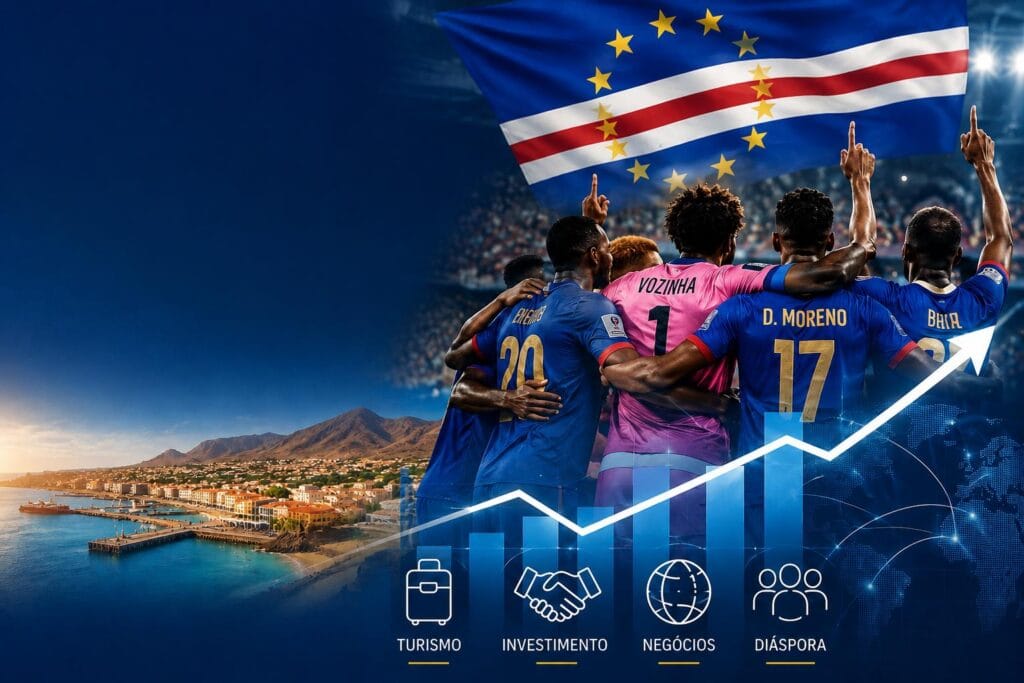
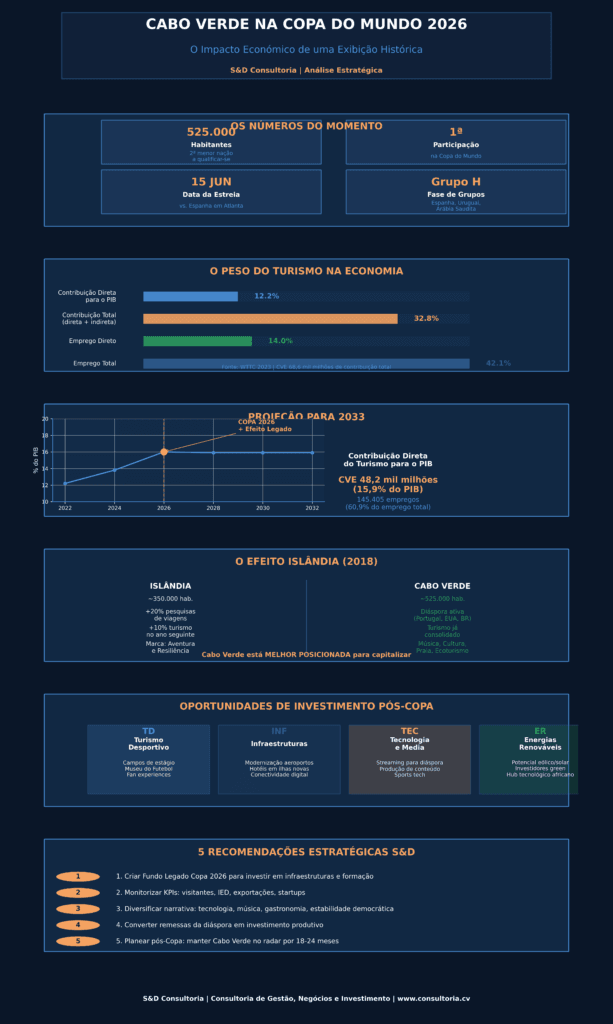
Yesterday, 15 June 2026, Cape Verde made history. The national team, the Blue Sharks, made its debut at the FIFA World Cup – the most-watched sporting event on the planet – against Spain in Atlanta. With a population of just over 525,000, it became the second-smallest nation ever to qualify for a World Cup, surpassed only by Iceland in 2018.
But this article isn’t about football. It’s about the economy, strategy and the value of global attention.
The Cape Verdean Government did not wait for the starting whistle to take action. In April 2026, it presented a integrated international promotion plan using a multi-phase approach – before, during and after the competition – with the clear aim of turning the World Cup’s media exposure into tangible economic results.
The strategy combines:
As the Minister for Tourism and Transport, José Luís Sá Nogueira, stated, the aim is to position Cape Verde as “a safe, competitive and diversified destination“.
To grasp the true economic impact of the World Cup debut, one must understand the pivotal role that tourism plays in the archipelago’s economy.
According to figures from the World Travel & Tourism Council (WTTC) for 2023:
The forecast for 2033 is even more ambitious: the direct contribution from tourism is expected to grow to CVE 48.2 billion (15.9% of GDP), with the sector bearing the brunt 145,405 jobs (60.91 per cent of total employment).
The 2026 World Cup is the biggest sporting event on the planet. With 48 teams (the first edition to feature this expansion), the tournament will attract billions of viewers all over the world.
The equivalent advertising value of the media exposure for a small nation such as ours is difficult to quantify precisely, but we can draw parallels:
Iceland, with a population of around 350,000, was, until 2026, the smallest nation to have taken part in a World Cup (2018). The economic outcomes following the World Cup were remarkable:
Cape Verde, with a well-established tourism offering (beaches, culture, music, ecotourism) and an active diaspora in Portugal, the US, France and Brazil, is best positioned than Iceland to capitalise on this visibility.
The economic impact is not automatic. Cape Verde faces structural challenges:
Success depends on strategic management, exactly the sort of management that the S&D Consultancy promotes.
See also: The 5 most promising sectors for investment in Cape Verde following the World Cup
Making one’s World Cup debut opens up specific investment opportunities:
See also: Where to invest in Cape Verde? The 7 sectors with high potential in 2025
See also: Cape Verde TechPark: a technology hub for the world
The Cape Verdean national team’s journey offers direct lessons for businesses and organisations:
| Football | Business |
|---|---|
| A blend of experience (Vozinha, aged 40) and youth (Sidny Cabral, aged 23) | Talent management and organisational succession |
| Captain Ryan Mendes’ leadership | Leadership in times of crisis and uncertainty |
| Coach Bubista’s strategy against the giants | Competitive strategy for SMEs in dominated markets |
| Teamwork with players from 10 or more different countries | Diversity management and remote/multicultural teams |
As a management and business consultancy, S&D sets out five recommendations for maximising the economic return from the World Cup debut:
Channel non-recurring revenue (from tourism, sponsorship and merchandising) into an investment fund for critical infrastructure and youth training, ensuring that the impact continues beyond July 2026.
Establish clear KPIs: number of additional visitors, foreign direct investment (FDI) attracted, value of non-tourism exports, growth in start-ups.
Cape Verde is more than just football and beaches. We should make the most of this attention to promote: technology, music (morna, coladeira), cuisine, ecotourism, and the model of democratic stability in Africa.
The Cape Verdean diaspora sends significant remittances to the country. Convert these flows into productive investment (property, tourism, agriculture) through specific financial instruments.
This “brief surge” of attention lasts for months, not years. We need an 18–24-month plan to keep Cape Verde on the international radar after the final whistle.
Our debut at the 2026 World Cup is more than just a sporting achievement. It is a case study in nation branding, on how a small archipelago can exert global influence far beyond its geographical and demographic scope.
The actual economic impact will depend on the ability to convert visibility to visitors, emotion in investment e a source of national pride in sustainable development.
The Government has already got the ball rolling with its integrated plan from April. Now it is up to the private sector, the diaspora and international partners to take the next steps.
At S&D Consultoria, we are closely monitoring these pivotal moments. If you represent an institution or company interested in exploring investment opportunities in Cape Verde, or if you wish to position your brand against the backdrop of this historic moment, please contact us.
See also: what banks and investors want to see in a business plan
Article based on data from the World Travel & Tourism Council, Forbes África Lusófona, WARC Media and a strategic analysis by S&D Consultoria.

 English (UK)
  Português (AO90)
  Français