

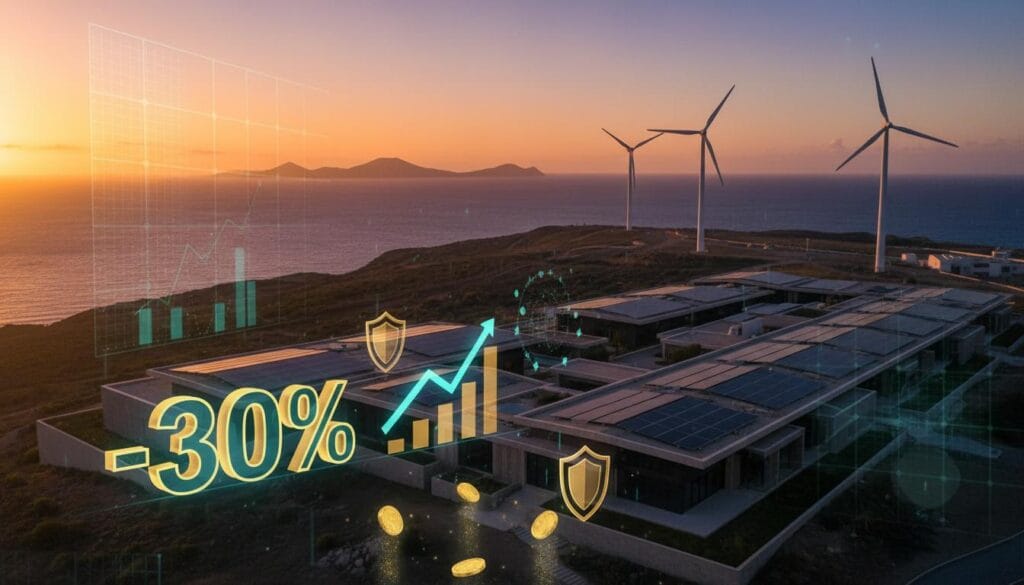
Cape Verde does not merely offer a competitive tax regime; it offers a active mechanism for reducing the tax burden for those who invest in the country’s strategic sectors. The tax credit from 30% to 40% scheduled for the Projects of Exceptional Merit (PMD) It is, without a doubt, the most powerful tool in this arsenal. This is not merely a tax cut: it is a direct deduction from the IRPC tax liability, which proportionally reduces the tax actually paid by the company. For projects in the sectors of the sustainable tourism and the renewable energies, two of the cornerstones of the archipelago’s development strategy, this mechanism could represent a tax savings of millions of euros throughout the investment’s life cycle. This article explains, in a practical and accessible way, how the tax credit works, who can benefit from it, and how the tourism and renewable energy sectors are particularly well placed to take advantage of this opportunity.
The tax credit for ‘Differentiated Merit’ Projects operates as a tax deduction scheme: the approved amount is deducted directly from the tax the company would otherwise have to pay. If a company has an IRPC liability of 10 million escudos and an approved tax credit of 3 million, it effectively pays only 7 million. The basis for calculation is the value of the relevant investments actually made, which means that the benefit is directly linked to the actual capital commitment to the project.
To qualify for LDC status, the project must meet all of the following criteria: investment of at least 1.5 million contos (approximately €13.6 million); contribution to improving the balance of payments; use of sustainable technology and processes; creation of at least five skilled jobs; and contribution to improving the quality of the domestic supply . The tax credit can amount to 40% when the project is implemented within the municipal area with Per capita GDP below the national average, which covers most of the islands outside the Praia–Sal–Boa Vista axis, where the greatest opportunities for tourism and energy development are to be found .
The scheme is supplemented by other exemptions: exemption from customs duties on the importation of raw materials and finished goods; reduced rate of 5% customs duties on the import of equipment; stamp duty exemption in financing operations; and IPI exemption in the purchase of property for the project’s premises . Emigrant investors also have an additional advantage: they can access the benefits of the PMD without the need to meet the minimum investment threshold.
Tourism is the the driving force behind the Cape Verdean economy, contributing around 20% of GDP and providing employment for thousands of people . The Strategic Plan for Sustainable Development (PEDS II) explicitly identifies the need for diversification of the tourism offering, focusing on health and wellness tourism, ecotourism, sports events tourism, cultural tourism and golf tourism — sectors that attract a clientele with greater purchasing power (HNWIs and UHNWIs) and generate greater added value for the economy .
The tax framework for tourism is particularly favourable. The Strategic Plan for Tourism Development provides for the classification of tourism investments according to strategic criteria, including the percentage of renewable energy use, a percentage of jobs for nationals, a percentage of revenue allocated to staff training and the type of solution for solid waste treatment . Tourism projects that meet these criteria – such as resorts with their own solar power generation, water recycling systems and local training programmes – are naturally well-placed to qualify for PMD status and the corresponding tax credit.
The projects currently under way illustrate the scale of investment in tourism in Cape Verde. The Defying Fate represents an investment of 32 million euros. The Ocean Cliff Old Town, in Praia, amounts to 228 million euros. A Riviera Mindelo, in São Vicente, with an estimated cost of 1.2 billion euros, is the archipelago’s largest tourism project . All these projects, given their scale and their structural impact, are eligible for the PMD scheme and for the tax credit ranging from 30% to 40%.
The synergy between tax credits and sector-specific incentives is particularly relevant for tourism projects on outlying islands. The exemption from the VAT 10% in the tourism and catering sector, the exemption from IPI at 0.1% per year on property and the possibility of accessing state-owned land for up to 50 years create an integrated tax package that significantly reduces the total cost of investment .
Cape Verde already has one of the cleaner energy mixes in Africa, but the ambition goes further than that. PEDS II sets out the the energy transition as a strategic priority, with increased investment in renewable energy, energy efficiency and sustainable mobility . The project AQUASUN, with an investment of more than 80 million euros On the islands of Santo Antão and Santiago, this is a prime example of this commitment: a modern agricultural initiative based on desalinated water and the use of renewable energy which demonstrates the economic viability of the green transition .
The renewable energy sector benefits from a range of support schemes. The Impact Fund, amounting to 10 million dollars, is intended to provide capital for SMEs in the tourism, manufacturing, fisheries and transport sectors, renewable energies, agribusiness and ICT, through equity investments for a term of 3 to 7 years, with a minimum of 10 million and a maximum of 100 million escudos per transaction . The Recovery Plan It also includes specific credit facilities for projects relating to energy transition through the use of solar panels to improve energy efficiency, with the support of CERMI (Centre for Renewable Energy and Industrial Maintenance) .
For large-scale projects in the renewable energy sector, the tax credit of 30% to 40% under the PMD scheme represents a direct and significant tax saving. A project 100 million escudos (approximately €907,000) invested in solar or wind power infrastructure can generate a tax credit of 30 to 40 million escudos (€272,000 to €363,000), deductible directly against IRPC tax liability during the first few years of operation. In larger-scale projects, such as AQUASUN, with its €80 million budget, the tax impact is proportionally greater.
| Investment Outlook | Amount | Tax Credit (30%) | Tax Credit (40%) | Estimated Tax Savings |
|---|---|---|---|---|
| Boutique hotel (outer island) | 50M$00 CVE (€453K) | 15M$00 CVE | 20M$00 CVE | €136K – €181K |
| Resort with its own solar power system | 200M$00 CVE (€1.8M) | 60M$00 CVE | 80M$00 CVE | €544K – €726K |
| Solar farm (Santo Antão) | 500M$00 CVE (€4.5M) | 150M$00 CVE | 200M$00 CVE | €1.36 million – €1.81 million |
| AQUASUN-type project | 8.8MM$00 CVE (€80M) | 2.6MM$00 CVE | 3.5MM$00 CVE | €24M – €32M |
The real opportunity lies in convergence of the two sectors. A tourism project that integrates on-site solar power generation, water desalination and water recycling systems, and sustainable waste management not only meets the PMD’s sustainability criteria, increasing the tax credit from 30% to 40% if it is located on a remote island, whilst also reducing operating costs throughout the project’s life cycle. On-site solar power reduces reliance on grid electricity – which is among the most expensive in Africa – and desalination ensures self-sufficiency water supply in an archipelago where fresh water is a scarce resource .
The Strategic Plan for Tourism Development explicitly states that the criteria for classifying tourism investments include the percentage of renewable energy use and the type of solution for solid waste treatment . This means that a resort which invests in solar panels, solar water heating and the composting of organic waste not only reduces its environmental footprint, it also increases your eligibility for enhanced tax benefits.
The tax credit from 30% to 40% is a powerful tool, but its activation requires rigorous technical preparation. The project must be structured from the outset to meet the PMD criteria; the supporting documentation must be complete and well-founded; and the application process must be managed meticulously in conjunction with the CVTI and the relevant authorities. A mistake during the preparation phase could cost the investor millions of escudos in lost opportunities.
A S&D Consultancy, based in Mindelo, São Vicente, supports foreign investors and entrepreneurs from the diaspora in the tax structuring of projects in the tourism and renewable energy sectors. The service includes the eligibility assessment for the LDC scheme, a drawing up business plans e feasibility studies which incorporate the fiscal variables, the preparation of application documents tax benefits, and the handling the process with public bodies. For those looking to invest in sustainable tourism or renewable energy in Cape Verde, S&D Consultoria turns tax benefits into real savings.
Cape Verde offers a competitive edge that few other destinations can match: a tax credit of 30% to 40%, combined with a framework of sector-specific incentives, a downward trend in the IRPC and a growing market. The tourism and renewable energy sectors are particularly well placed to capitalise on this opportunity. The question is not whether the investment is worthwhile, but whether the investor is prepared to structure the project in such a way as to maximise the return. The S&D Consultancy invites you to book a strategic consultation and discover the tax potential of your project in Cape Verde.
S&D Consultoria – Mindelo, Cape Verde. Business consultancy, business plans, feasibility studies, company formation, tax management and tax optimisation for sustainable tourism and renewable energy projects.

 English (UK)
  Português (AO90)
  Français